Sunday, January 22, 2012

15°51′43″N 97°04′18″W

Puerto Escondido, on Barrade Colotopec.
Sept. 27 to Oct. 5, Mexico City to Puerto Escondido: A warm ocean, seashell beaches, crashing tidal waves, and ice cold coca-cola in a glass bottle: this was Puerto Escondido. After spending nearly 10 days in the smog of Mexico City, we arrived in tiny Puerto and took a deep breath of fresh air. Hot, humid, and sticky fresh air. Stepping off the air-conditioned ADO bus we had sat on for the past 18 hours was like being forced to suddenly stand in a sauna, except there was no exit door to escape the heat. Puerto was hot. I've never been so hot in my entire life.

Our catch: a dorado (green) and two tuna.
We jumped into a taxi cab and paid $2 for a ride to our first hostel of the trip, Tower Bridge Hostel, at the end of a dirt road and across from a Mexican woman's laundry business. The hostel had a pool, and that's all that mattered. Because we were there during the low season (high season doesn't start usually until mid-November) Ben and I were given an awesome private room with a king size bed and own living area for just $20 a night. Immediately we rushed off to one of the many beaches in Puerto, Playa Carazalillo, for a swim.
Girls can fish, too!
The beach sits in a tiny bay and is scattered with local food vendors and women trying to sell you hemp and seashell necklaces. The water wasn't refreshing; it was hot, and the waves continually knocked the feet out from under numerous people, sending them slamming down into the sand. We quickly developed a routine: wake up, eat, go to the beach, come to the hostel and swim, go back to the beach, eat, sleep. It was delightful. On our second day there, we awoke at 7 a.m. and hopped into a tiny pickup truck with Omar, a local fishermen who runs a sports fishing business. We got into his boat at Playa Principal, scattered with anchored fishing boats in the bay, and headed out onto the ocean. It was incredible. Within 15 minutes of letting out the fishing line, we caught two average-sized tuna (bonita fish) and a green, scarred dorado (also called Mahi Mahi, or dolphin fish). I decided that lake fishing in B.C. was not for me; it is much easier to catch a fish in the big, bad ocean. Meanwhile, we had been in search of dolphins, sea turtles, and whatever else we happened upon.

Swimming with sea turtles.
Omar's assistant fisherman, Juan, leapt into the ocean at one point to chase after a sea turtle - we had seen plenty at this point, many of which were mating - and grabbed onto this turtle before it had the chance to dive under the water. We got to swim out in the middle of the ocean and touch it. It was the one thing I had wanted to do during out trip, and we had managed to achieve it only two weeks in. 

Afterwards, we saw what I first thought was a shark. A gray, sleek fin sticking out from the water right near our boat. Omar inched towards it and he suddenly yelled with excitement, "A moonfish!" Apparently this fish, actually called the Ocean Sunfish or Mola Mola, is incredibly rare to see.  Having fished for more than 20 years in Puerto, Omar has only seen one "moonfish" before in his life. He and Juan ran all over the boat snapping pictures of this fish, which grows as big as a dinner table and as flat as a pancake. Seeing this giant blue fish swim next to our boat was a rude awakening to the complexities of the ocean, which houses more creatures than we are even capable of grasping.
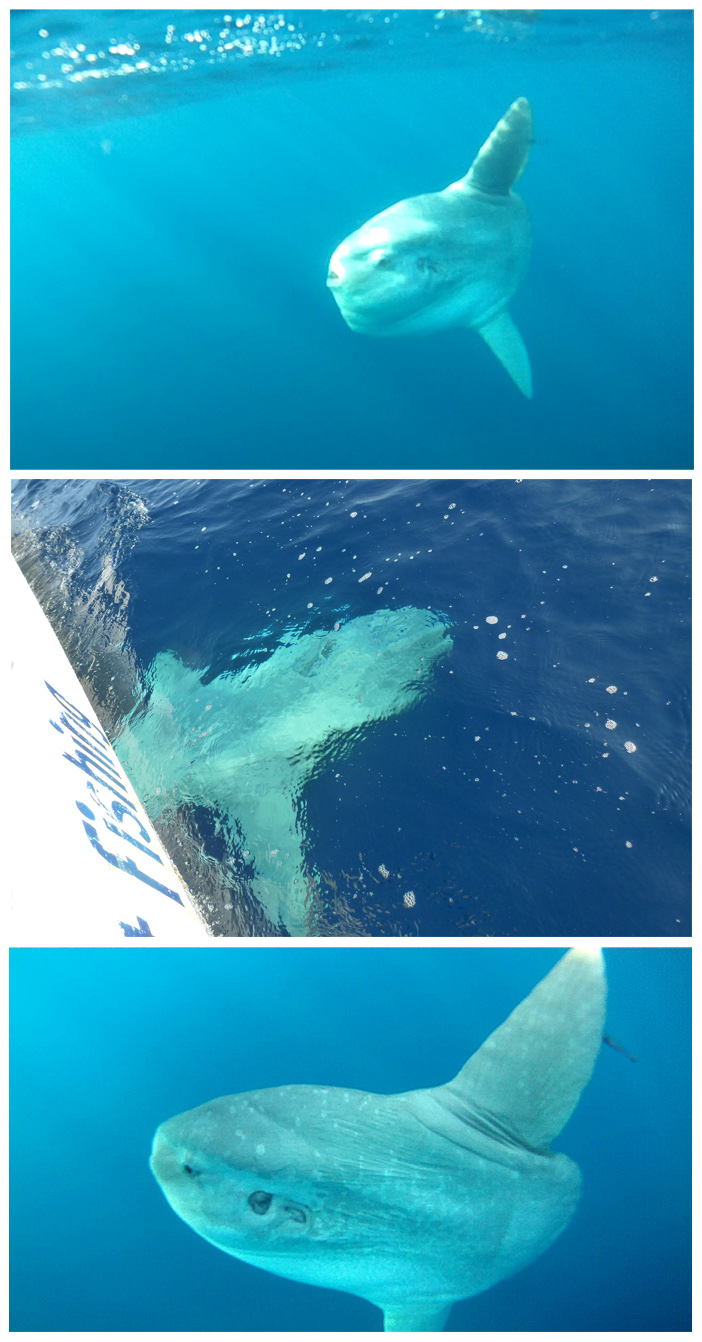
Ocean Sunfish, the size of a dinner table.
Thankfully, Ben had his new GoPro camera, and we were able to get some underwater photos and video (above) of the fish. We made our way back to Puerto a couple hours later and paid $50 pesos to have our fish cooked up. We sat on the beach and ate it for breakfast.

Playa Carazalillo, my favourite Mexico puppy,
and a swordfish pulled up onto the beach.
The next few days in Puerto involved surfing, drinking coca-colas on the beach and eating my favourite, al pastor with fresh pineapple and cilantro. We went to the beach every day, and Ben bought himself a surfboard while we were down on the main street at Playa Zicatela one night. I was hesitant to surf; I'm a confident swimmer and I love the water, but put a surf board beneath my feet and I become unsteady and nervous. Still, I tried one day while at La Punta, after hiding under my Swedish friend Milje's sarong in search of shade. It was a thrill to actually catch a wave and ride it into shore. A local offered me his extra surfboard and gave me a push into the wave. He didn't want money, but I assume he noticed I was the only one sitting on the beach watching in envy at my friends and Ben floating in the waves, and threw me a pity party. It was a lovely party, though.

Walking a path between beaches along the rock. We had
to be careful of incoming waves. The heat was unbearable.
Two days later, after a night of throwing up due to an untimely bout of heat stroke, Ben awoke me from my slumber. He had gone to the beach to surf a few hours earlier while I stayed in bed. "I stepped on a sea urchin and I need to go to the hospital," he said. Reluctantly, but for the love of my boyfriend, I pulled myself awake and escorted my boyfriend, whose foot was bleeding and punctured with sea urchin needles, to the local medical clinic.

Find a palm tree, grab a coconut!
For the next three hours I watched as a doctor and his assistant used needles to extract fragmented urchin spines from Ben's foot. It was easily 40 degrees Celsius in town, and I ran between the clinic and a nearby internet cafe in an attempt to organize how we would claim the doctor's bill on our travel insurance. I have never been so sweaty, so hot in my entire life. But I do believe Ben had never been in such incredible pain in his entire life either. There was no freezing, but Dr. Mario Cruz did the best he could digging in his foot. Some urchin spines were left in as they were difficult to extract - Dr. Cruz said Ben's body would eventually push them out.

Ben's injured urchin foot, sitting in the medical clinic with
Dr. Cruz. Incredibly painful.
We spent a few more days in Puerto, reading books on the beach and eating an incredible amount of fresh guacamole, and getting to understand the local lingo, the local troubles, and the Mexican struggle. I spoke with a man on Playa Carazalillo at one point about the difficulties of trying to get a Mexican passport, nevermind a visa to travel. The limits that are cast down upon the people in their own country is incredibly difficult to understand coming from a country who's people are so free. 
Our favourite Swedes, Milje and Casper. 
There was also another guy who, having grown up in Puerto, said he had never been to Mexico City, or nearby San Cristobal. He lives with his grandmother, works as a surf instructor, and has a shark tattoo on his arm. This is his life. But he's happy. I fell deeper and deeper in love with Mexico while in Puerto Escondido. The people were warming up, I was growing more comfortable, and we were beginning to understand that there is a community of travellers all around the world, including in Puerto.

You should probably just go and feel it for yourself. Go catch a fish, swim with a turtle. Just go.

Things I learned in Puerto:
1. People are incredibly helpful, especially Swedes. Casper and Milje sat with Ben and pulled urchin spines from his foot on the beach.
2. Having travel insurance is easily the most important thing to have while traveling. 
3. As much as I love the heat, when I began wishing for snow in Mexico just to cool down a bit, I realized I was not climatized for that crap.
4. Three weeks into our trip, I realized we were about to have a lot of fun.

F.U.N.

Monday, January 16, 2012

Teotihuacan: the first ruins

The Pyramid of the Moon, and my best friends. Also, looking from the Pyramid of
the Moon towards the avenue of the Dead, and the Sun pyramid.
When you've reached Mexico byway of the unbeaten path, you quickly discover it is a rock garden of stone cities and prolific culture, where the study of Anthropology never quiets and dies. When you stand atop an ancient pyramid, the second-largest in the Americas, and look out over a city of stone and squares, it is hard not to feel infinitesimal. You are hit with a wave of irrelevancy about your own existence as you walk on the cobbled roadway built by age-old civilizations. And as you climb the steps of your first pyramid - steps twice the height to which you would normally climb - you can no longer claim ignorance to the magnificent formations that man has created.

Atop the pyramid looking towards
the Moon pyramid, and Ben and I in a square.
This is how it felt to climb the Pyramid of the Moon, the Pyramid of the Sun, and walk the Avenue of the Dead in the ancient Aztec city of Teotihuacan. This was our first encounter with ruins during our Central America trip. Canada is so young and so void of archeological riches that to walk onto land that trembles with stories was like being a child again and walking into your neighbourhood candy shop for the first time. You sit on top of the first pyramid, just like you would stand in the doorway and gaze at the colorful candies, and look out at something that you think you understand - that once there was a king who ruled a land and men built this city for him - and then you realize you know nothing at all.

Renee and I with Pyramid of the Sun.
On the second day of our three month backpacking trip, we hopped on a bus with our friends Renee, Chrissy and Said, and went to Teotihuacan. The vastness of the Pyramid of the Sun could be seen even as we drove in via taxi to the park entrance. It towers above the rest and dominates the skyline like a protruding mountain, except this mountain is constructed of thousands of volcanic rocks and there is a set of stairs leading to the so-called "summit." The pyramid stands 71.2 metres tall, with a base perimetre of 894 metres. Archeologists have concluded that the pyramid was constructed beginning in 100 A.D. This is further back than even myself can comprehend.

With the possibility to hold more than 200,000 inhabitants, it could have been one of the largest cities in the pre-Columbian Americas. Still, there is no evidence that solidifies which ethnicity actually lived here - the Aztecs gave the present-day names to the site, but there are a number of ethnic groups that the city could have belonged to.
Common themes in Teotihuacan of rich kings surrounded by slaves. 
All of this aside, as we ventured through the city on a hot Sunday afternoon, I carried with me a smile that I could not escape. Even as ambulantes (people trying to sell you artifacts, jewelry and other items) bombarded you with their colourful obsidian knives and sparkling silver earrings, I felt immersed in a culture I had no idea existed. To even bear witness to a small part of Mexican history, to see for myself the stacked stones and to hear the tales of sacrificial lives for the good of a king, it was unlike anything I have ever experienced.

The best part is, this was just the beginning.

You know you're in Mexico when: On our bus ride back from Teotihuacan, we were stopped by police who asked all of the men to step off the bus. Not wanting Ben to get off, I told him to stay. A woman behind us said, "He has to go. They are looking for guns." I watched out the window as Ben was told to lean against the bus with his legs and arms apart, and then as a cop patted him down. Alas, no guns.

Saturday, January 7, 2012

Viva la vida viajando

The itinerary: The boyfriend and I had three months to make it from Mexico City, in central Mexico, to Panama City, Panama. There was no plan to stick to. We had particular destinations in mind, but no reservations, no pre-purchased tickets and no notion of what it was going to be like, who we would encounter, what challenges we would have to face. We just went. 
Living the Travelling Life

Flying into Mexico City.
Mexico City - When you've never travelled extensively, arriving in one of the largest cities in the world at the start of a backpacking trip is not a gentle, genial way to begin. Mexico City, with a population so high that officials can't even say how many people live there, is more congested than my sinuses in the middle of February. When you finally escape the crowded MEX airport, and you wind up on a dark street lit with one street lamp, where everything seems darker than it normally would at 9:30 at night, a search for a taxi is not the thrill you'd think.

The Zocalo, with Parliament on top and
Catedral Metropolitana, oldest church
in Latin America.
Fortunately, the excitement of commencing a three month trip I had been waiting months for overshadowed some of that fear on the first night we arrived in Mexico. That, and the three friends that came to pick us up because they know Mexico City better than I ever will. That helps, too.

We jumped into the taxi, and I ignored vigorously all those things people had said before we left: "Mexico is SO dangerous right now. Why are you going there?" And suddenly the taxi driver is holding his horn down and driving in the middle of two lanes on a bustling highway, and I'm reaching for the seatbelt to contain my insides and calm my nerves, but there isn't one. But it doesn't matter. The point of travel is to immerse oneself into another, foreign culture. If this culture meant no seat belts, then so be it.
Art and the Aztec Calendar in the Museum
of Anthropology, Mexico City.

Mexico City's official city proper population is around 9 million people. But the surrounding metropolis area contains more than 21 million people. The city has an incredible history: many years before its existence the Aztecs (Mexican people) were migrating through the region in search of a place to settle. Led by a god, Huitzilopochtli, they were told that when they saw an eagle atop a cactus, holding a snake in its beak, they were to settle in that particular area.  The Aztecs, after years of travelling, saw a serpent in the mouth of an eagle at the current site of Mexico City, then called Tenochtitlan, and began to build the city on an island, surrounded by Lake Texcoco.

Mexican soldiers taking down the Mexican flag in the Zocalo, Mexico City.
After having spent a week in Mexico City, I could tell the story of the eagle and the serpent held great meaning. The Mexican flag bears an eagle with a serpent in its beak, and can be seen in almost every corner of the city, paper flags taped to the dash of every taxi cab, in every restaurant and blowing in the wind at every park. In the city centre, the zocalo, the largest flag I have ever seen blew in the wind at the top of a flagpole, the reds and greens of the Mexican flag towering over the people that stand below it. While there myself, it was hard to ignore the deep affection that Mexicans themselves have for that flag, and their country. 

Chrissy, Renee and I in Coyoacan, and in the
Zocalo, in front of the cathedral.
The city is so rich in history, and so rich in tragedy. I heard many stories while I was here - the beauty of travelling to a place you've never been. You become so engulfed in what has occurred, what is happening, what tragedies and triumphs a city has encountered, that you begin learning far more than you ever would by just reading up on a book about the particular area.
One night while we sat in the zocalo, as I watched while hundreds of people marched around the square, protesting the

firing of more than 40,000 electrical workers (the president is working on privatizing electricity in Mexico - another disconcerting issue) a friend told me about the Tlatelolco massacre. Ten days before the summer Olympics in 1968 were held in Mexico City, a group of 10,000 university and high school students gathered to peacefully protest the Olympic Games, demanding a fairer government and looking to that government to provide basic necessities for its people. Instead, snipers stationed throughout this particular square opened fire on the students, killing between 200 and 300, and injuring hundreds more. The electrical protesters continued on through the square, many shouting "Viva Mexico!" as I listened.

El Angel, commemorating Mexico's independence,
and a view of the city centre from atop the Latin
American tower, downtown Mexico City.
Mexico has many demons that few people are aware of, the stories I heard are evidence of that. And when the dark secrets are exposed, they cloud the outsiders eyes of what real beauty the city, and the country, holds. I write about the darkness because that was what had me questioning visiting Mexico in the first place. In truth, I was wrong about it. Those people who doubted us going were also wrong.


So what did we do in Mexico City? Everything we could fit into nine days. We visited the monument El Angel, the Angel of Independence that towers above the city, constructed in 1902. We spent a day at the Six Flags Mexico City theme park - for an unauthentic experience. We walked the streets of La Condesa, where my friend Renee lived. We ate frozen ice cream from a plastic tube and walked through Coyoacan, a former village of the city, and I watched in amazement at the indigenous dancers bearing rainbow colors of feathers on their headdresses, with nuts tied around their ankles and dancing in unison to the giant beat of the drums. We scrambled through crowded markets with candles and incense burning my nose.

Indigenous dancers in Coyoacan: the woman on the right is providing a
traditional blessing for people in the audience.
We spent hours wandering through the rooms of the Museum of Anthropology, which houses some of the oldest artifacts discovered in Mexico, and some of the oldest mummified remains of sacrificial slaves in surrounding ancient cities. I saw the enormous Aztec Calendar that archeologists pulled from the centre of the city. And I got to see all of it with people that I really care about, which made it that much more worthwhile.
Tradition, culture.
Mexico City was a great way to start a three month backpacking trip. From the moment we landed it was as though we had walked through a solid door and into a room painted with all sorts of colours and cultural riches, filled with people who love the way they live, who carry an undying compassion on their shoulders for their country. It wasn't scary at all. It was exhilarating. If anything, before leaving the city I became envious of the culture they carry with them.

Photo credit: Ben Ross and Jessica Bell

Saturday, December 24, 2011

there were a thousand other faces

"Old Streets of Antigua, Guatemala"


I have so many photos that I am dying to post, but time is short for now because of the holidays. Once I head back into Fernie, there will be an abundance of posts and stories and photos. I promise. Merry Christmas to all my blog followers! I'm back!

The trip was incredible. I have learned an incredible amount about the cultures in Mexico and Central America, and have a new outlook on life here in Canada. The richness of the individual people in Central America, the simple lives they live, and the warmth they surround you with has truly enlightened me.

More to come, very soon.

Thursday, October 6, 2011

A donde fueres, haz lo que vieres

"Wherever you go, do as you see."

Two men with their borro in tow on the beach.
We are almost three weeks into our trip, and there are so many, many stories that have accumulated on the sheets of paper in my journal, that it is difficult to narrow the utmost important down. For they are equally influential in this journey.

We left Mexico City in a hurry last week, on an 18 hour bus ride to Puerto Escondido. Cramped, uncomfortable, trying to sleep as the bus swerved down curves on the Mexican highways, arriving at check stops every couple of hours, men holding fully-loaded machine guns, searching for criminals, searching for anyone who doesn't quite belong. Like ourselves. The busses are given the go ahead, so we don't need to stop, but my nerves are so wound up no sleep comes easy.

Juan and Omar, our fish guides, with a bonita fish.
But Puerto is beyond words. We step off the bus to stretch our legs and are met with a blanket of humid weather, my palms suddenly sticking to everything they touch.

I've learned that traveling quickly becomes a part of who you are; aching for the next destination, embracing whatever it is that the locals do, whether it be surf at this beach or that, eat this food or that. If you just take a step further, out from the hostel or the hotel or the resort that you feel so safe in, you wouldn't regret it. I'm becoming immersed in Mexico, and want to further myself as a traveller here, not as a tourist.

In all honestly, it is the people that make it so. Not the beaches, not the cheap jewelry. The people.

Playa Zicatela (Zicatela Beach) at sunset.

Saturday, September 24, 2011

el sabor de Mexico

The sound of Oaxaca cheese sizzling on a taco on the grill on the street, the spices, the Spanish floating to my ears; I can't understand much, if any. I am in Mexico. It is mucho bueno. It is so incredible, and so different, and so not easy to summarize into a small blog post. A taste of Mexico in my first week. 

Debido a que es tan hermoso que tiene que ser compartido.
Because it is so beautiful, it has to be shared.

Teotihuacan, Pyramid of the Sun.
The best friend, the blanca Mexican!
Zocalo, the centre of Mexico City, with Parliament.
A non-authentic Mexican day at Six Flags.
Traditional Aztec prayer and dancing in Coyocan.
 Who knows where we'll be next week. 

Friday, September 16, 2011

travel, journey, voyage, explore, backpack.

Travel and change of place impart new vigor to the mind. - Seneca


I'm sitting on my bed, in my room, in Canada, and I don't really want to be here. And tomorrow, I won't be. Nor will I be for the next three and a half months. Because I am going to Mexico and Central America! I have no idea where I will be in a week: the only thing I know is that at 8:05 p.m. tomorrow night I will have landed in Mexico City, quite possibly the biggest city in the Western Hemisphere (21 million people). I will be going for tacos with my long-time Fernie friends and my new Mexican friends, and on Sunday, I'll be walking through Teotihuacan.

Packing for such a trip has proven to be most demanding. I have a 75 litre bag, with the desire to only fill half of it. But, alas, that is impossible. I've tried desperately to cut back on my belongings: a pair of Toms, a pair of hikers, flip-flops, a sheet (for those nasty hostels with nasty sheets), soap, lotion, 6 pairs of underwear/socks, three pairs of shorts (one jean, swim, lulu), long johns (for those long nights in the highlands of Guatemala), two pairs of jeans (comfy, skinny, 'cuz a girl has to have her skinny jeans), my Loki rain coat, two shirts, three tanks, one long sleeve, an American Apparel sweater, eye cover (for dreary hostel sleep ins when I want to drown out the light), and nick nacks of medicine which includes: advil, aleve, cream, carmex, a knife, a lock, Immodeum (diarrhea prep) and Malaria pills. This is not all I have in my bag, but it's all I will include so as not to overwhelm those of you reading this.

I was nervous. For a long time. Will a bring the right things? What am I forgetting? Will I be safe? And now, I'm just so excited there are tingles passing through my veins and my mind is constantly invaded with thoughts of climbing Maya pyramids and surfing turquoise blue waters, of swimming with sea turtles and drinking tequila with the local senoritas!

There is nothing more exciting that not knowing where I'll be. I never thought I'd say that. Packing through Mexico, Guatemala, Belize, El Salvador, Nicaragua, Costa Rica and Panama. All of them. Adios, Canada! Hola, adventura!


For my avid followers, I will be making a full-hearted time investment into blogging about the trip as it happens. They may be informal, short blogs, but if you are interested, follow along!

Sunday, September 11, 2011

good to have the sun on my face again

The water is so clear and so blue on my eyes that it makes me wish I could see underwater. Like a fish. Or a frog. Every time I make the hike up to Silver Springs, and ascend on the cliffs that overlook the lake, a rush of gratitude envelopes me. A deep breath in, a slow breath out, my eyes graze the lake that is so close to where I grew up. And even after what feels like hundreds of visits, the amazement remains.

A 23 foot leap off a jutting rock takes me deep into the water, but as I lean with my toes clutched to the edge, the jump I've done many times before leaves my heart thudding faster than it ordinarily would. And then I leap, and the water shoots up my nose, and I'm swimming in the deep blue to the surface where the sun warms my face. It's cold. I'm so completely at home. My own little Eden. Even if there are 30 others who feel just the same, now standing on the rocks above me.

Monday, August 22, 2011

Climbing a mountain, or two.

At 1350 metres in elevation and six kilometres in, after having carried a 40-pound backpack through switchbacks for the last two-and-a-half hours, the pain in your shoulders becomes almost numb. The first three kilometres is a struggle; not yet in your element, with every step up towards your destination your legs shake. Your hips, where the waist straps of your bag sit, are aching and in connection with your hip flexers are sending signals to your brain saying, "Sit down, now." Still, you can't. If you sit, you won't get up. And if you won't get up, you won't see what you and your friends are determined to see, even if it takes all of your might to see it.

The Barrier lava dam as viewed from 1300 metres. Click
on the photos for a detailed view.
Last weekend myself, Ben, Jess Moir and Jamison Herron - after having spent far too much time in the city - felt it was time to hike into Garibaldi Park. Halfway between Squamish and Whistler, the park is one such area that is difficult to find words to describe. Not many people are aware it even exists, as most usually rush past it to get to Whistler. We packed our bags: emergency blanket, long johns, toque, sweater, extra sweater, hikers, socks, extra socks, toothbrush, can of beans, trail mix, sunscreen. Trying to prepare yourself for an overnight hike, without overpacking, is a challenge I haven't quite mastered. Trying to do so when you've heard there is still 2 metres of snow at the camp where you're headed, is even more troublesome.

Not deterred, however, we began or ascent up the mountain, passing fellow hikers (or in my case, being passed) - some hiking in, others hiking out. We made our way past the six-K mark, and then to The Barrier. For my fellow geography buffs, The Barrier needs no explanation. Still, it is such a remarkable remnant of the changing earth that it deserves attention. The Barrier is a lava dam that retains Garibaldi Lake. According to my good friend Wikipedia (and my knowledge collected last year from a Geography field trip), its thickness is 300 metres and is 2 kilometres wide. The volcano responsible for the flow is Mount Price, and more specifically, Clinker Peak (a west vent of Mount Price). At the time of eruption (9,000 years ago) a glacier existed in the Cheakamus River valley and the lava flow halted against it to form the barrier.

The area below The Barrier is extremely dangerous, so much so that the village of Garibaldi (below it) was relocated. It's possible that The Barrier could collapse following an earthquake or another event. Seeing it in its entirety was tremendous.

Finally at Garibaldi Lake, where we stopped to view the lake
trout and indulge in our finally arriving.
Past The Barrier, it's another 2.5 kilometres to Garibaldi Lake and the campsite. The hike in from this point is beautiful - crystal clear lake water, streams and then the turquoise blue of Lake Garibaldi. Was there snow like what we had read? Absolutely. So much, in fact, that we had to trek around in search of a site that was snow-free, and upon failing, Ben and Jamison dug out a snow pit for our two tents. We ate lunch, unpacked, went for a walk and then spent the next few hours making dinner, playing cribbage, and recuperating from the 9.5 kilometer hike-in. Whiskeyjack (Gray Jay) birds were landing on our hands, and chipmunks were sitting at our feet. The rainbow trout swam in the lake. There was no sign that just hours before we had been surrounded by concrete and high-rises.

The following morning, after spending a cold, rainy night on the ground, surrounded by snow and wrapped in our sleeping bags like caterpillars in their cocoons, we were up and began our next hike. Garibaldi Park offers endless hiking opportunities and deciding which ridge to climb or mountain to conquer is more difficult that the venture itself (figuratively speaking). Thanks to Ben's topographic map, we decided on Mount Price for its yet unexplored territory (Jamison had already climbed the Black Tusk).

We did a bit of bushwhacking before finding the not-so-beaten trail in some crowded and rocky forest on the south-west portion of the lake near Battleship Islands. At first not even sure we were going anywhere (for our lack of knowledge about the trailhead), we quickly began hiking, not quite sure of where we were headed, excluding the moment when Ben pointed out, "We're going up there!" Marked only by flagging tape and a few faded footprints in the snow, we hiked towards Mount Price.

Mount Price and its vent, Clinker Peak (left and right); Jess and
Ben with a view of Garibaldi Lake in the background, and an old lava flow.
The hike mainly exists along the ridge of an old lava flow and partially through the flow itself. We zig-zagged through a basalt rock field that once would have been a solid flow of lava, now broken up after hundreds and thousands of years of weathering processes. The view from the ridge of Garibaldi Lake, and the surrounding landscape including Panorama Ridge, was a site to see.

Further up the ridge along the 4 kilometre ascent we encountered a colossal amount of snow. This past winter blanketed Garibaldi Park with so much white stuff the potential for colourful wild flowers was burried deep beneath. Instead, we gathered ourselves walking sticks and remained on top of the snow as we continued on our exploration.

As we reached the bottom of Clinker Peak, I noticed red streaks in the snow. Jamison informed me that what looked to be red spray paint was actually red algae, or watermelon snow. The algae, which is green algae with a "secondary red carotenoid pigment" thrives in freezing water and is common during summertime at alpine elevations.

Hiking in the snow towards Clinker Peak; Jamison, Jess and
Ben making their way upwards, and myself taking in the view.
Now on the ridge of Clinker Peak (reminder: this is where the flow that created The Barrier came from) the volcanic eruptions of its past became distinct. The direction of the lava flows heading towards The Barrier and into Garibaldi Lake, were easy to distinguish and even more remarkable from such a high elevation (1900 metres). The volcanic igneous rock beneath our feet, included Andesite, Basalt, and Pumice, was a geologist's dream come true. Reds, blacks, oranges, a rainbow of rock types. And the view from the summit of Clinker Peak of Garibaldi Lake was so vast that you simply cannot capture it in a 24 mm wide lens. At this point we ascended up a snow field and the view was so breathtaking that the aches in my legs were virtually non-existent.

Nearing the top of Clinker Peak, and Ben with the beginning of an incredible landscape.
Once at the top of Clinker Peak, we walked down into a concave between the peak and Mount Price. It was here, upon climbing towards the pinnacle of Mount Price, that the true limitless of Garibaldi Park set in.

Jamison and I heading into the concave dip before climbing
to Mount Price; Ben with the most incredible view.
To the southeast of us came into view The Table, the Warren Glacier, Garibaldi Neve and Mount Garibaldi. The Table (seen to Ben's left in the bottom photo) sits at 2,021 metres and formed beneath the Cordilleran Ice Sheet. Behind The Table is Mount Garibaldi - for all intents and purposes - an active stratovolcano. At 2675 metres in elevation, the volcano is concealed by glacial snow. Even now, these photos do not do the landscape justice. "Wow. Wow. Wow." It's all I could muster up to say.

Minutes later, after digging through and picking up large chunks of Pumice, we made it to the top of Mount Price. A flat, rounded summit, Mount Price was by far the best choice for a hike. A 360 degree view from the peak (at 2052 metres) showed Garibaldi Lake, Panorama Ridge, lava flows and the glacier kingdom of Garibaldi Park.

No words. Just splendor.
We weren't at the peak for more than a half hour before the blue sky gave way to ominous clouds. As we explored the top, gray cloud moved into the mountain and concern about ill-tempered weather had us packing up and heading down. What was a steep and slippery climb through snow and rock on the way up turned into a fun slip-and-slide ride on our rain coats as we descended. No walking necessary - we wrapped our jackets beneath our bums and slid down the mountain. I may have had a little too much fun, but it's not every day you get to play in the snow in the middle of August.

Two hours later we were back at camp, packed up, and making our way down the dreaded switchbacks back to the truck. By nightfall we were still on the trail and, for some time, I sang to myself in the dark before Ben convinced me to strap on my headlamp. At 9 p.m., nearing the parking lot, my feet began to throb. Every step closer on the path sent agonizing pain through my body. After having hiked for nearly 15 hours in less than two days, my sprightliness for exploring dispersed. My back pained. My legs cramped. My feet swelled. My heart delighted.


All aches and pains were made up for with a view like this. Go the Garibaldi Park. Even looking at this, it gives little insight into actually being there and seeing for yourself how amazing it is to climb a mountain, or two.

Two roads diverged in a wood, and I - I took the one less traveled by, And that has made all the difference. - Robert Frost.

Thursday, August 4, 2011

Room between me and the ground.


As we ascended off the tarmack at Squamish Airport, what I thought would be nervousness in my first flight in a single-engine plane was actually utter excitement. The headset was on, the engine roared to life, and my good friend Stuart - who recently received his private pilots license - pulled back on the control column and sent us flying in the air. In seconds we were escalating above ground.

Before take-off he gave us the tutorial: "This is the tracking device incase we crash. Put your seat belt on like this. If I say 'hands off,' don't touch anything." And then, as if he had been doing it for years, Stu flew up to 7,000 feet in the air and imprinted within me an entirely different view of the Coast Mountains around Squamish and Whistler. A bird's eye view, if I dare to sound cliche.

 We saw the Stawamus Chief, not from the highway as most do, but at 3,000 vertical feet. The vastness of the granitic monolith is even more astounding from the air. And then we flew - in attempt to reach our desired elevation - through Garibaldi Provincial Park, which encompasses a volcanic field of nine different stratovolcanoes.

It was like a geography dream come true. You could see where glaciers from thousands of years ago used to sit in the earth, that have now melted away and left the ground transformed. And more, you could see the amount of volcanic activity that shaped the land in the first place during the Holocene (11,000 years ago). Above you can see the lateral moraine, a Roche Moutonnee (thanks to Malcolm's knowledge below) and U-shaped valleys from glacial activity.

And then you've got Garibaldi Lake, which is, in itself, absolutely astounding. It's depth is at 300 metres and exists due to a lava flow from Clinker Peak that created a lava wall barrier during the last ice age. The blue colour is the result of rock flour - ground up sediment from the glacier that, when the sun hits it, reflects the water in a bright blue. Adjacent to the lake is The Table, which formed below the Cordillera Ice Sheet. Flying directly next to and above these features, having never seen them at any close distance, was breathtaking. Not even an hour from Vancouver there is so much left to explore.

Stuart then flew us in our loop past Mount Cayley, seen behind me here. Mount Cayley is a "potentially active volcano" that rises 7,428 vertical feet. Upon further reading I discovered that Mount Cayley poses future eruptions, with hot springs steaming up on the western flank. Also, seismologists have recorded earthquakes as early back as 1985, a sure sign that volcanic activity still exists beneath the mountain.


As we began our descent back to solid ground, pilot Stuart and the other passengers (myself excluded) decided that Negative G's would be a hilariously fun form of entertainment. As I gripped my hands tightly to the bottom of the seat, Ben and Mikey giggled like school boys in the back. I resisted the feeling of floating and yet my body leapt into the air as the plane dove. All was not well in Jesse's insides. Still, I refrained from throwing up and took a photo of the two, much more thrilled passengers. Flying is fun. Seeing the reflection of the tiny single-engine plane on the trees below had me feeling nostalgic. However, I can't quite put into words what flying through a volcanic belt, with glaciers staring back at you, is like. It's like knowing something is beautiful but the description of it isn't tangible.

The modern airplane creates a new geographical dimension. A navigable ocean of air blankets the whole surface of the globe. There are no distant places any longer: the world is small and the world is one. - Wendell Willkie
Related Posts Plugin for WordPress, Blogger...